


Here’s Our Complete 2026 Ford F-Series Towing Guide
Towing numbers get thrown around a lot, and they rarely mean the same thing from one truck to the next. A 13,500-pound rating on one F-150 configuration and an 8,200-pound rating on another both wear the same badge, and the gap between them matters when you are hooking up a camper or a horse trailer. This guide breaks down exactly what the 2026 F-Series can tow, model by model and engine by engine.
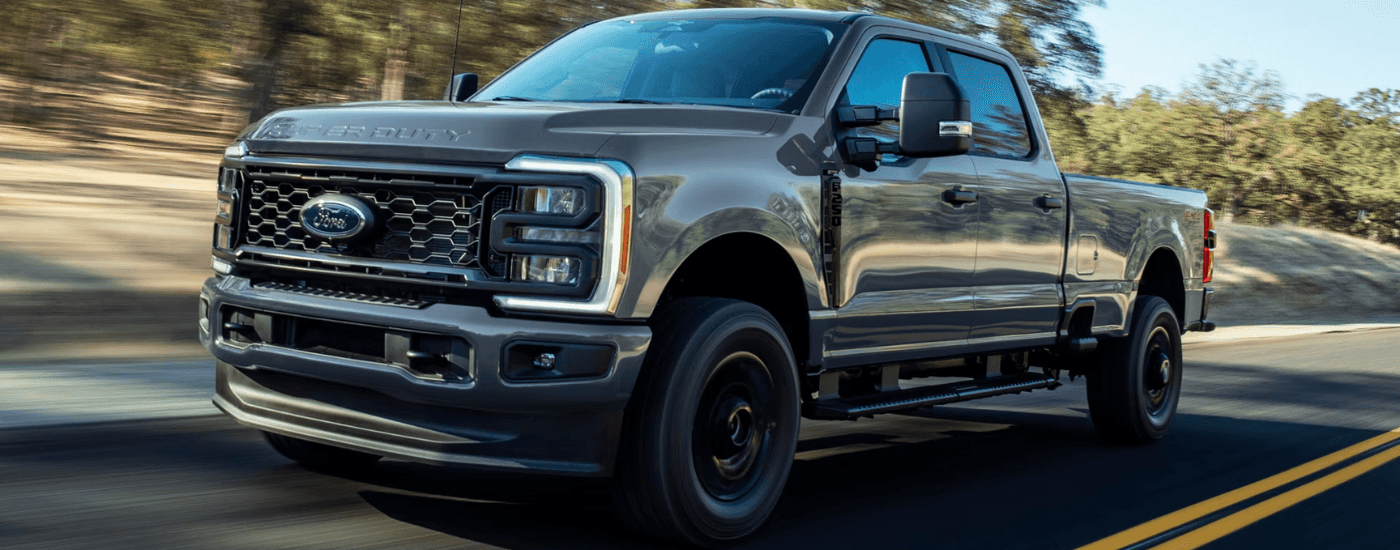
The 2026 Ford F-Series spans four truck lines built for different jobs: F-150, F-250, F-350, and F-450. Towing tops out around an estimated 13,500 pounds on the F-150 and climbs to an estimated 40,000 pounds on a properly equipped F-450 with a gooseneck hitch.
Our team at Parks Ford Hendersonville works with drivers across Hendersonville, Asheville, and Greenville who tow for very different reasons, from weekend boats and campers to horse trailers headed for Tryon International Equestrian Center. This guide walks through towing capacity by engine, the off-road trims built for local trails, and how to figure out which F-Series truck actually fits your load.
Key Points: 2026 Ford F-Series Towing Capacity
- The F-150 tops out at an estimated 13,500 pounds with the 3.5L EcoBoost V6, 4WD, and the right axle and towing equipment. Other F-150 engines tow less, so the engine you choose matters as much as the trim.
- Super Duty towing scales dramatically by model. The F-250 starts around an estimated 17,300 pounds and the F-450 reaches an estimated 40,000 pounds on a gooseneck hitch, a jump most shoppers underestimate.
- Off-road capability and max towing are a trade-off. The F-150 Raptor tows less than other F-150 trims by design, since its suspension and tuning target high-speed off-road performance instead of maximum hauling.
2026 Ford F-Series Towing Capacity at a Glance
Four truck lines, four very different jobs. Here is how the 2026 F-Series breaks down before we get into engine-by-engine detail.
| Model | Engine Highlight | Max Towing | Best For |
|---|---|---|---|
| F-150 | 3.5L EcoBoost V6 | Up to est. 13,500 lbs | Boats, campers, daily driving |
| F-250 | Available Power Stroke diesel | Up to est. 23,000 lbs | Larger trailers, work loads |
| F-350 (DRW) | High-output Power Stroke diesel | Up to est. 38,000 lbs (gooseneck) | Heavy equipment, horse trailers |
| F-450 | High-output Power Stroke diesel | Up to est. 40,000 lbs (gooseneck) | Maximum-capacity hauling |
Figures are manufacturer estimates and require specific configurations, including engine, cab, bed length, axle ratio, and hitch type. Contact Parks Ford Hendersonville to confirm the exact setup needed to reach these ratings.
A few things stand out once the lineup is side by side. The jump from F-350 to F-450 adds only about 2,000 pounds of gooseneck capacity, which surprises a lot of shoppers who assume the F-450 is a much bigger leap. The F-150’s estimated 13,500-pound ceiling requires a specific build, not just any 3.5L EcoBoost truck off the lot. And every Super Duty engine option pairs with the same 10-speed TorqShift transmission, so the towing difference between trims comes down almost entirely to engine choice.
Towing Capacity vs. Payload vs. GCWR: What the Numbers Actually Mean
Three separate ratings determine what a truck can actually handle, and mixing them up leads to trouble. GVWR (Gross Vehicle Weight Rating) is the maximum weight of the truck itself, fully loaded with people and cargo. Payload is the maximum combined weight the cab and bed can carry, found by subtracting the truck’s curb weight from its GVWR. GCWR (Gross Combined Weight Rating) is the maximum weight allowed for the truck and a loaded trailer together, and it’s the number that ultimately sets towing capacity.
The marketing max you see in headlines, including the ones in this guide, reflects one specific configuration. The number that matters is on the tire and loading placard inside your specific truck’s door jamb, since engine, cab, bed length, and axle ratio all shift the actual rating up or down.
2026 F-150 Towing Capacity by Engine
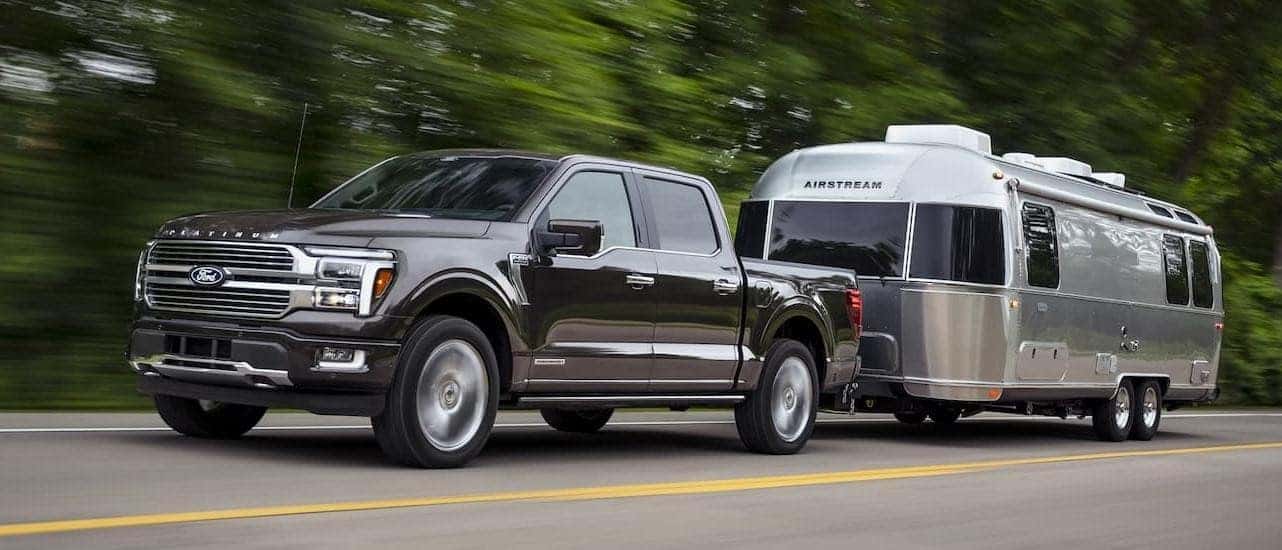
The F-150’s towing capacity changes significantly depending on which engine sits under the hood. The 2.7L EcoBoost V6 tows up to an estimated 8,400 pounds, a solid number for smaller trailers and boats. Step up to the 5.0L Ti-VCT V8 and that climbs to an estimated 12,900 pounds.
The 3.5L PowerBoost, a hybrid V6 that pairs a gas engine with an electric motor for added low-end torque, tows up to an estimated 11,200 pounds while also running as a mobile power source through Ford’s Pro Power Onboard system. The 3.5L EcoBoost V6 leads the lineup at an estimated 13,500 pounds, but only in a specific build: 4WD, SuperCrew cab, 6.5-foot bed, Max Tow Axle, and the Tow/Haul Package.
F-150 Off-Road: Tremor and Raptor
The Tremor and Raptor take the F-150 off pavement, and each does it differently. The Tremor pairs the standard 3.5L EcoBoost’s 382 horsepower with 33-inch all-terrain tires, a locking rear differential, Trail Turn Assist, and full underbody skid plates, making it a practical match for the trailheads at DuPont State Recreational Forest and Pisgah National Forest. It still tows up to an estimated 10,200 pounds.
The Raptor pushes further with a 450-horsepower High-Output EcoBoost, and the Raptor R adds a supercharged 5.2L V8 making 720 horsepower alongside Fox Racing Shocks and 37-inch tires. Towing capacity drops to an estimated 8,200 pounds on the Raptor, a deliberate trade-off since the suspension and tuning prioritize high-speed off-road performance over maximum hauling.
2026 Ford Super Duty Towing Capacity
Super Duty towing comes in two flavors that get confused often. Conventional towing uses a rear-bumper hitch and covers most boats and travel trailers. Gooseneck towing uses a hitch mounted in the truck bed, the setup most horse trailers and heavy equipment trailers require, including the trailers headed to Tryon International Equestrian Center.
The F-250 starts at an estimated 17,300 pounds of conventional towing with the standard 6.8L gas V8 and climbs to an estimated 23,000 pounds with the high-output 6.7L Power Stroke, Ford’s diesel engine line built specifically for heavy-duty torque. The F-350 dual-rear-wheel model reaches an estimated 28,000 pounds conventional and an estimated 38,000 pounds on a gooseneck hitch. The F-450 tops the lineup at an estimated 40,000 pounds gooseneck and an estimated 35,000 pounds fifth-wheel, both requiring the high-output Power Stroke diesel.
Super Duty Off-Road: The Tremor Package
Unlike the F-150, the Super Duty Tremor is an off-road package rather than a standalone trim, available on XLT, Lariat, King Ranch, and Platinum. It adds 35-inch off-road tires, a rear electronic locking differential, a front limited-slip differential, performance shocks, raised front springs, and water-fording vent tubes.
Rock Crawl, Trail Control, and Trail Turn Assist round out the drive modes, the same off-road technology found on the F-150 Tremor, scaled up for a heavier truck. For Super Duty owners who split time between towing during the week and trail access on the weekend, the Tremor package keeps both jobs covered on one truck.
Ford Towing Technology That Makes These Numbers Usable
A big towing number only helps if the truck makes it manageable, and the 2026 F-Series backs its ratings with real hardware. Pro Trailer Backup Assist lets the driver back up a trailer by turning a knob in the direction they want it to go, while Pro Trailer Hitch Assist steers, brakes, and accelerates the truck automatically to line up with the coupler.
Ford Smart Hitch uses onboard scales to measure tongue weight in real time, helping confirm a trailer is loaded correctly before it ever leaves the driveway. An available integrated trailer brake controller and the Smart Trailer Tow Connector, which monitors trailer lights and battery health, round out a setup built to make big numbers practical rather than just impressive on paper.
How to Confirm Your Exact Towing Capacity Before You Buy
The fastest way to know a truck’s real towing number is to check the tire and loading information placard inside the driver’s door jamb, which lists the GVWR and payload for that specific vehicle. Ford also publishes detailed towing guides by configuration for further reference.
Since engine, axle ratio, and equipment all move the final number, the most reliable step is bringing your trailer’s weight and hitch type to our team. We can match a specific 2026 F-Series build to your exact load before you sign anything.
Which F-Series Truck Fits Your Towing Needs?
The right truck comes down to what you are actually pulling, not just how big a number sounds impressive.
- Boats, campers, and daily driving: The F-150 with the 3.5L EcoBoost covers most weekend towing without stepping up to a Super Duty.
- Horse trailers or heavy equipment: The F-250 or F-350 with a Power Stroke diesel and gooseneck setup handles the load Tryon-area trailers demand.
- Maximum-capacity hauling: The F-450 with the high-output Power Stroke diesel tops the lineup for the heaviest gooseneck trailers.
- Weekend trail access at DuPont or Pisgah: The F-150 Tremor or Raptor trades some towing capacity for real off-road hardware.
Explore the 2026 F-Series at Parks Ford Hendersonville
Parks Ford Hendersonville is located at 601 Duncan Hill Rd., Hendersonville, NC 28792, serving drivers across Hendersonville, Asheville, and Greenville. Our team can help match the right engine, axle, and towing package to the load you actually haul.
Browse our 2026 Ford F-150 inventory or check our 2026 Ford Super Duty inventory to see what is available today. The best way to confirm a truck fits your towing needs is to bring your trailer by and see it in person.
0 comment(s) so far on Here’s Our Complete 2026 Ford F-Series Towing Guide